

How to become a ghostwriter: skills, pricing and clients
To become a ghostwriter, learn to write convincingly in someone else’s voice, build a set of samples you are allowed to show, pick a type of ghostwriting to start with (blog posts, LinkedIn posts, books or speeches), set a clear pricing model, and find clients through your network and the people who already serve them. The rest of the job is process: a good interview, a written contract and reliable delivery.
This guide walks through each step, from what the work involves to pricing, contracts and getting referrals.
Last updated: 7 November 2026
What is ghostwriting?
Ghostwriting is writing that is published under someone else’s name. The client is the named author. You do the research, interviewing, drafting and revising, and the client approves the final version and puts their name on it.
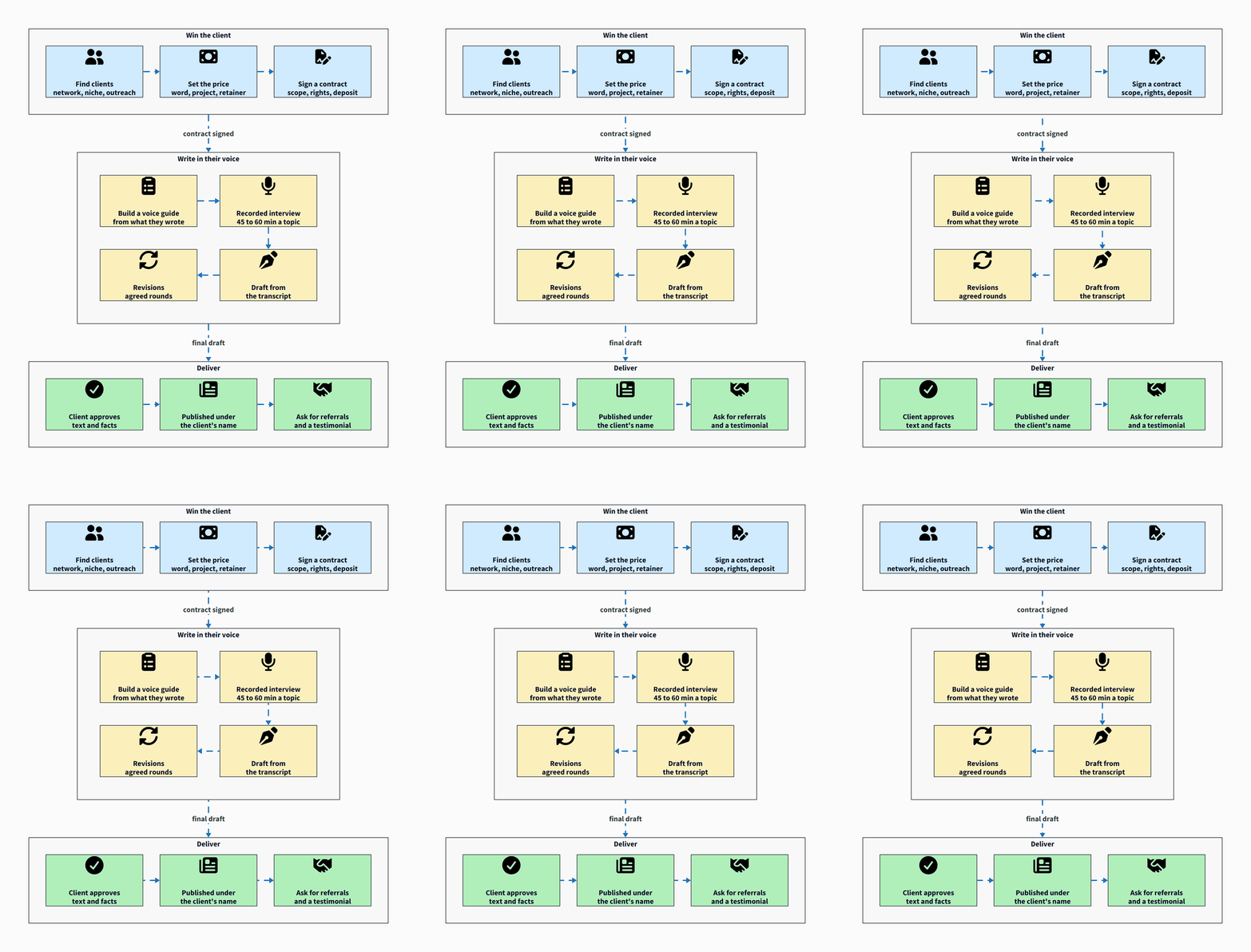
The most common kinds of ghostwriting are:
- Books: memoirs, business books and expert nonfiction for people who have the knowledge and the story but not the time or writing skill to produce a full manuscript.
- Blog posts and articles: posts for company blogs, guest articles and opinion pieces published under a founder’s or executive’s name.
- LinkedIn and X posts for founders: short, regular posts that build a founder’s reputation. This is often ongoing monthly work.
- Speeches and talks: keynotes, conference talks, wedding speeches and internal company addresses.
Short social posts reward speed and a sharp ear for opinions. Books reward stamina and structure. Speeches must sound natural spoken aloud.
How is ghostwriting different from copywriting or editing?
A copywriter usually writes for a brand, and the reader knows it is the company speaking. An editor improves text the author already wrote. A ghostwriter writes the text from scratch, but in a specific person’s voice, so that it reads as if that person wrote it. Voice is the product.
Is ghostwriting ethical, and who gets the credit?
Ghostwriting is a long-standing, accepted practice. Speechwriters write for politicians and executives, and professional writers help public figures with their books.
The ethics depend on the ideas and the context:
- The ideas should be the client’s. You shape, organise and phrase their experience, opinions and expertise. If you invent opinions or experiences they don’t have, the work stops being their voice and becomes a deception.
- The facts should be true. Never invent stories, results or quotes to make a piece more compelling. The client’s reputation is on the line, and so is yours.
- Some settings don’t allow it. Academic work such as essays, theses and coursework submitted for assessment is a clear line. Writing it for someone else is academic misconduct, not ghostwriting. Some publications and contests also require that entries are the named author’s own work. Decline these jobs.
Credit is agreed in the contract. The default is no credit: your name appears nowhere and you don’t tell anyone you wrote it. Some clients agree to an “as told to” or “with” credit on a book, or a thank-you in the acknowledgements. Others allow you to say privately that you worked with them, without naming specific pieces. Always ask, and always get the answer in writing.
What skills do you need to be a ghostwriter?
Good grammar is the minimum. These are the skills that separate ghostwriters clients keep from ones they replace after a month.
Voice matching
You need to hear how someone talks and reproduce it: their sentence length, favourite words, humour (or lack of it), how formal they are, and the phrases they would never use. Practise by reading three or four pieces by a writer you know well and writing a new paragraph in their style. Then compare it with their real work and look at where it drifts.
Interviewing
Most ghostwriting starts as a conversation. You need to ask open questions, follow up on the interesting answer instead of moving to your next question, and get specific stories and examples rather than general statements. “Tell me about a time a hire went wrong” gets better material than “What do you think about hiring?”
Research
You will often write about industries you don’t know. You need to read quickly, check facts against original sources, and know when to ask the client instead of guessing. For expert content, a factual error under the client’s name is the fastest way to lose them.
Structure and editing
Clients give you raw material in the wrong order: tangents, repetition and the best point buried at minute forty of a call. Your job is to find the argument and build the piece around it. This matters most for books, where you may be organising dozens of hours of interviews.
Discretion and reliability
You will hear confidential business and personal details. Keeping them private and meeting deadlines are part of the job.
How do you build a ghostwriting portfolio when your work is unattributed?
This is the main problem every new ghostwriter faces. Your best work carries someone else’s name, and you may have signed a non-disclosure agreement (NDA). There are four honest ways around it.
- Write samples in your own name. Publish articles, a blog or LinkedIn posts under your own name, on the topics and in the formats you want to be hired for. If you want to write for SaaS founders, write sharp posts about SaaS. Our guide on how to start a blog covers setting one up.
- Write “voice samples”. Pick a public figure with lots of published interviews and write a short post as if it were by them, clearly labelled as an unpublished sample written to show voice matching. Never present it as real or publish it as theirs.
- Ask past clients for permission. Some clients are happy for you to show specific pieces privately to prospective clients, or to be named as a reference. Put a clause in your contract that asks for this, and respect a “no”.
- Use anonymised descriptions. If you can’t show the work, describe it without identifying the client: “Wrote 40 LinkedIn posts over six months for a fintech founder” (only if true, and only if your NDA allows it).
Your public presence is part of your portfolio. Clients hire ghostwriters they can find and trust, so writing under your own name also works as marketing. See how to build a personal brand for how to do that without it taking over your week.
How much should a ghostwriter charge?
There are three common pricing models, and most ghostwriters use more than one.
- Per word: simple for articles and blog posts. The risk is that it rewards length rather than quality, and it ignores interview and research time.
- Per project: a fixed fee for a defined piece of work, such as a book, a speech or a set of ten posts. This is the most common way to price books. Your fee should cover interviews, research, drafting and an agreed number of revision rounds.
- Retainer: a monthly fee for an agreed volume of work, such as twelve LinkedIn posts and two newsletters per month. Retainers suit ongoing social media and blog work and give you predictable income.
What do professional ghostwriters charge?
The Editorial Freelancers Association’s 2026 rate chart publishes median rate ranges from a survey of its members about the rates they charged in 2025. The EFA says over 1,100 members responded, and that it neither sets rates nor advises members on what to charge. Rates are in US dollars. These are some of its ghostwriting figures, checked on 7 November 2026:
| Ghostwriting type | Per word | Per hour |
|---|---|---|
| Articles and essays | 15 to 30 cents | $75 to $100 |
| Blog posts | 25 to 40 cents | $75 to $100 |
| Business and marketing | 50 cents to $1.00 | $87.50 to $125 |
| Nonfiction, short-form | 27.5 to 50 cents | $70 to $75 |
| Nonfiction, full-length | 33 to 50 cents | $85 to $100 |
| Memoir | 50 cents to $1.00 | $80 to $100 |
Treat these as a reference point, not a price list. They reflect one association’s members, many of whom are experienced, and the EFA notes that individual rates vary with the type of work, turnaround time, expertise, local cost of living, training and years of experience. Beginners and writers selling into other markets often charge differently.
How do you set your own rates?
Work it out from your time, not from a number you saw online:
- Estimate the hours. Include the interview, transcription review, research, drafting, revisions, calls and admin. For a book, interviews and organising material can take as long as the writing.
- Pick a target hourly figure. Base it on what you need to earn, the hours you can realistically bill each week, and what comparable work pays in the market you are selling to.
- Multiply, then add a buffer. Projects almost always take longer than planned. Add a margin for this.
- Convert to the client’s preferred model. Quote a project fee or a monthly retainer, but know the hourly figure behind it so you can tell when a job is underpriced.
For example, if a 1,000-word blog post takes you five hours from interview to final draft, a per-word rate that works out to less than your target hourly figure across those five hours is too low, however standard it looks.
How do you find ghostwriting clients?
Your first clients usually come from people who already know you. Start there, then widen out.
- Your existing network. Tell former colleagues, managers and friends in business what you now do and who it is for. Be specific: “I write LinkedIn posts for B2B founders” is easier to refer than “I’m a writer.”
- Pick a niche. A clear audience (fintech founders, doctors, real estate agents, academics writing popular books) makes you easier to find and recommend, and lets you learn one industry well.
- Write in public. Post useful content under your own name where your ideal clients spend time. For founders, that usually means LinkedIn or X. A prospective client who reads your posts sees your writing before they ever speak to you.
- Partner with adjacent services. Editors, designers, marketing agencies, PR firms, literary agents and book coaches regularly meet people who need a writer. Some agencies subcontract writing to freelancers.
- Professional directories and groups. Organisations such as the Association of Ghostwriters describe themselves as professional organisations for ghostwriters of books, articles, speeches, blogs and social media, and run member directories. Check what any membership actually offers before paying.
- Direct outreach. Find people who clearly have expertise but post rarely or inconsistently, and send a short, personal note with one specific idea for a post they could publish. Keep it brief and don’t send templates in bulk.
How do you capture a client’s voice?
A repeatable process is what makes ghostwriting work. Here is one you can adapt.
1. Collect what already exists
Ask for anything the client has written or said: emails, old posts, slide decks, podcast appearances, conference talks and recorded interviews. Spoken material is often more useful than written, because it shows how they really talk.
2. Build a voice guide
Write a one-page document for each client covering:
- tone (formal or casual, serious or playful)
- typical sentence length and structure
- words and phrases they use often
- words, topics and opinions to avoid
- their core beliefs and recurring stories
- how they open and close a piece
Update it after every round of feedback. It becomes more accurate over time.
3. Run a recorded interview
Book 45 to 60 minutes per topic, record it with permission, and get a transcript. Prepare questions, but follow the conversation. Good prompts include:
- “What do most people in your industry get wrong about this?”
- “Tell me about a specific time that happened.”
- “What would you say to someone just starting out?”
- “What’s an opinion you hold that your peers would disagree with?”
When you hear a good line, ask them to say more. Their exact words are the raw material for an authentic piece.
4. Draft from the transcript
Pull the strongest stories and phrases from the transcript and build the piece around them. Keep their wording wherever it works. Mark anything you added or inferred so the client can check it.
5. Review and calibrate
The first few pieces for a new client are calibration. Ask for specific feedback (“Does this sound like you? Which lines would you never say?”) and expect more revisions early on. After a few rounds, most clients need very few changes.
What should a ghostwriting contract include?
This section is general information, not legal advice. Contract and copyright law vary by country. For a large project, such as a book, have a lawyer in your jurisdiction review your contract.
Every ghostwriting job, even a small one, should have a written agreement covering:
- Scope: exactly what you will deliver (number of words, posts, chapters or speeches), the deadlines, and what is not included.
- Confidentiality: what you may and may not disclose, including whether you can ever say you worked with the client.
- Credit: no credit, an “as told to” or “with” credit, or an acknowledgement.
- Ownership and rights: who owns the copyright in the finished work and when it transfers. Clients normally expect to own it, often once they have paid in full.
- Portfolio use: whether you can show the work privately to prospective clients.
- Revisions: how many rounds are included, the turnaround for each, and the rate for extra rounds.
- Payment terms: the fee, a deposit before you start, milestone payments for long projects, the invoice due date and what happens if payment is late.
- Cancellation: what you are paid for work completed if the client stops the project partway through.
- Facts and approvals: that the client is responsible for approving the final text and confirming the facts and claims made under their name.
Who owns the copyright in ghostwritten work?
Ownership is the clause to get right. In the United States, the U.S. Copyright Office explains that copyright exists automatically once an original work is fixed, and that ordinarily the author is the person who actually created it. An exception is a “work made for hire”. According to the Copyright Office’s circular on works made for hire, a commissioned work only counts as made for hire if it falls into one of nine listed categories (such as a contribution to a collective work, a translation or an instructional text) and both parties sign a written agreement saying so.
In practice, that means writing “work made for hire” in a contract may not cover every type of ghostwriting, such as a standalone book. Contracts often include an explicit transfer (assignment) of copyright as well. This is exactly the kind of clause to have a lawyer check, and the rules in your country may be different.
How do you deliver work and get referrals?
Most ghostwriters grow through repeat work and referrals, so delivery is also marketing.
- Add a short cover note. List any facts the client must confirm, any lines you are unsure about, and what you need from them next.
- Meet every deadline. If you will be late, say so early with a new date.
- Ask for a referral at the right moment. The best time is right after the client is pleased: a book launch, a post that performs well or a speech that lands. Ask directly: “Do you know anyone else who’d benefit from working like this?”
- Ask for a testimonial. Offer to draft it for their approval, and agree on whether it can be named or must stay anonymous.
What mistakes should new ghostwriters avoid?
- Starting without a contract. A short email that both sides agree to is better than nothing, but a proper agreement protects you on scope, payment and rights.
- Working without a deposit. Ask for part of the fee upfront, especially from new clients and on long projects.
- Underpricing interviews and revisions. Writing is only part of the time. Price the whole process.
- Writing in your own voice. If every client sounds like you, you aren’t ghostwriting. Use a voice guide and their own words.
- Inventing material. Never make up stories, numbers or quotes to fill a gap. Ask the client instead.
- Breaking confidentiality. Never name a client or share their work publicly unless the contract allows it. One slip can end a relationship and your reputation.
- Unlimited revisions. Define the rounds included. Endless rewrites usually mean the brief or the interview was unclear, so fix the process.
- Taking work you shouldn’t. Turn down academic assignments and anything that requires you to deceive readers about facts.
Frequently asked questions
Do you need a degree to become a ghostwriter?
No. Clients hire ghostwriters based on samples, voice matching and reliability. A background in journalism, marketing or a specialist field can help you win clients in that area, but it isn’t required.
Can a ghostwriter put client work in their portfolio?
Only if the contract allows it. Many ghostwriting agreements forbid any disclosure, so ask for permission in writing, and otherwise use samples written in your own name or clearly labelled voice samples.
Is ghostwriting legal?
Yes, ghostwriting itself is legal and widely used for books, speeches and business content. It is not acceptable for academic work submitted for assessment or where rules require the named author to have written the work.
How do I start ghostwriting with no experience?
Choose one format, such as LinkedIn posts for founders, publish samples in that format under your own name, tell your network what you offer, and take a few small projects to build testimonials.
Should I charge per word or per project?
Per word is simple for short articles. For books, speeches and anything with interviews, a per-project fee or monthly retainer usually reflects the real work better. Base either on an estimate of your hours.